
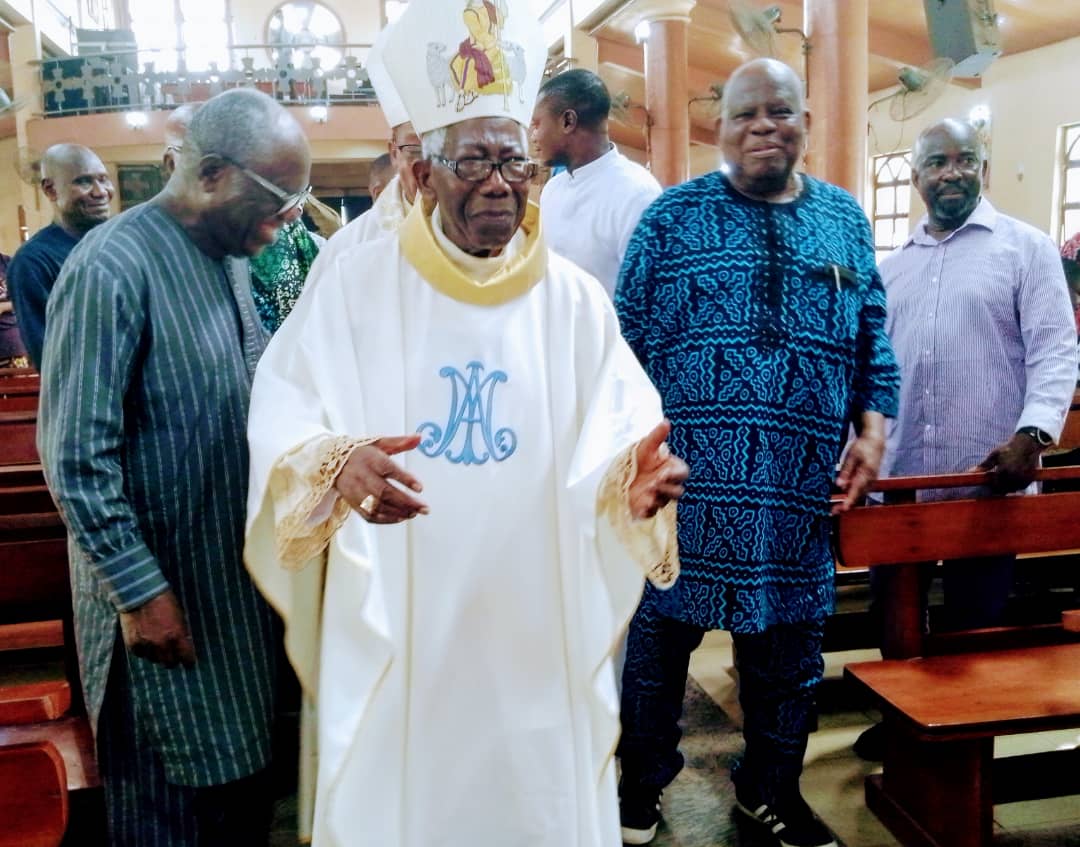
ARCHBISHOP FELIX ALABA JOB – THE GALLANT SHEPHERD OF IBADAN
-
by
admin
- Introduction
In “The Merchant of Venice,” the famous English writer, William Shakespeare, speaking through the mouth of Graziano to Antonio said: “All the world’s a stage, and all the men and women merely players: they have their exits and their entrances; and one man in his time plays many parts, his acts being seven ages.”‘ A man that fits perfectly into the mould cast by Shakespeare is Archbishop Felix Alaba Adeosin Job; a man who has been described as an orator, an elegant Bishop, a fearless preacher of the Gospel, a statesman, an energetic builder but above all a shepherd of God’s flock. This chapter chronicles and examines the life and accomplishments of Felix Job with the aim of preserving these accomplishments as reference points for other ministers of the church and humanity in general. The paper will thus, examine the life of Felix Alaba Job; as man, the priests and then the Bishop. These three aspects of the man capture the main stages of his life’s background, his work, and his accomplishments.
- Early life
On the 24th of June 1938, the cry of joy was heard again in the family of Augustine Osinlana Ade Job and Mrs. Hannah Idowu Job of Esure, Ijebu Imusin, in Ogun State of Nigeria. Coming second after the birth of twins, everyone knew he would be called Alaba. “Alaba paari olobe ide’ (the one with the bronze knife). In Yoruba culture, a child born to the same woman after birthing twins is called Idowu and the child after Idowu is called Alaba, what this means is still lost to many people. Needless to say, this Alaba became a fearless man and an uncompromising statesman. No wonder, the Yoruba believes that “Ile la nwo ka to s’omo l’oruko” meaning that names are not given arbitrarily, the family looks at the background and the life situation in a particular family to determine the name to be given a newborn. This newborn brought his name from heaven, and as Marion Zimmer Bradley once said, “Flowers and fruit are only the beginning. In faithful, the seed lies the life and the future.” From his birth, it was obvious that “Feli” was destined for greatness. Alaba was a unique boy born on the solemnity of St. John the Baptist, a man who is forever associated with greatness. Why then was Alaba not named after John the Baptist? According to Felix Job, his parish priest, Fr. Lawrence Layode, the Son of the Basorun of Oyo, baptised him on July 1, 1938.
The priest looked at him when he was brought for baptism and declared, “This boy is my joy first joy in this family, he shall be called Felix.” Thus, he was promptly baptised with the name Felix; a name that accompanied him everywhere in his ministry as he sought to bring joy, peace and salvation to the sheep entrusted to his care. Felix began his academic pursuit at St. Paul’s Primary School, Odogbolu from 1946-1948, he then moved to St. Peter Claver’s Primary School, Esure from 1948-1953. Between 1954 and 1959 he had his secondary education at St. Theresa’s Minor Seminary, Oke-Are, Ibadan. Full of zeal for the Lord God of Host as Prophet Elijah puts it in 1Kings 19:14, Felix Alaba Job opted for the priesthood and began his priestly formation at SS. Peter and Paul Catholic Major Seminary, Bodija, Ibadan which lasted from 1960 – 1963 and later at the Pontifical Urban University, Rome, from 1963-1967.
- The Man Felix Alaba Job
Felix Job as man projects the image of a strong man, sometimes with intimidating voice and presence, a quality that bestows on him not only a hero’s poise, but a godlike, larger than life presence. But Felix Alaba Job is a deeply emotional man. For instance, the news of his mother’s death struck him like a thunderbolt, and while appearing strong to the crowd, it was a different response when he got to the parish house. According to him “when I got there, I wept my eyes out because we were very close indeed”. But he had that strong character not to show weakness in public. This was a superhuman task that he would not always be strong enough to keep. Narrating this event at his episcopal ordination, he wept at the mention of his mother not being present at the occasion. He said, “I thank those who begot me in flesh and in spirit. My father is here and when I mentioned how I wish my mother were present, I burst out crying. That was the first time I wept in public. We were very close; we were really very close”.
Felix Alaba Job is a man, a full man to the core, but he allowed the grace of God to work and shine in him. Thus, the words of St. Irenaeus: “The glory of God is for man to be fully alive’ rings true in him. Felix Job was an elegant man, and this would become more apparent when he became a priest and put on the solemn garments that priests wear for Mass. To some, “he likes to show off” but for him “decency is no pride.'” That was his MOTTO in the Primary School. This has been the way he lived his life and the standard with which he judged others. Apart from his mother, some other people also made a deep impression on the young Felix, especially Fr. Galvin and Archbishop J.K.A. Aggey who was his Parish Priest. Of Aggey, he recounts, “Fr. Aggey was my encouragement for the priesthood and he was the one who recommended me to the Minor Seminary.” During his long years of priestly formation as a seminarian he worked in various parishes. After his seminary formation, Felix Job was ordained a deacon of the Catholic Church in Rome. Upon his return to Nigeria, Rev. Felix Job was ordained priest at Esure on the 24th of December 1966.
- The Priest
Following his ordination, Fr. Felix Job was appointed the Parish Priest of Ajilete and Ilaro parishes from September 1967 to September 1969, and also the Parish priest of Ado-Ado parish in February 1969. As destiny would have it, Rev. Fr. Felix Alaba Job was seconded to Ibadan and appointed Rector of his own alma mater St Theresa’s Minor Seminary. He held this position from September 1969 to 1974. One of the qualities clearly discernible in the young Felix was his love for God and commitment to the good of the people around him. Of him could be addressed again those words of Shakespeare that we read in Hamlet: “Doubt thou the stars are fire; doubt that the sun doth move; doubt truth to be liar; but never doubt love”. His love for the people never waned, such that even after many decades, Felix Job could still be found speaking with gusto about his life and ministry at Ajilete and environs. He was young, vibrant and hardworking, a combo that endears him to the people. Felix Job was cut for the job and became the people’s priest, apparently because he was a priest after God’s own heart.
The Prophet Jeremiah recognised God in his life and in his call to ministry when he said the Word of the Lord was addressed to him as follows: “Before I formed you in the womb, I knew you; before you came to birth, I consecrated you; I appointed you as prophet to the nations” (Jer 1:4-5). These very words were fulfilled in the life of Rev. Fr. Felix Alaba Job on the 11th of March 1971 when he received his letter of appointment as auxiliary Bishop of Ibadan Diocese from Rome. Just as St. Thomas Aquinas, the Angelic Doctor of the Church rejected his appointment as Archbishop of Naples, so also in that same spirit of unfeigned humility did Rev. Fr. Felix Job refuse his own appointment. He said he would serve the Church better as a priest than as a bishop. With seven visits by Bishop Anthony Saliu Sanusi, Fr Felix who had earlier said he was unworthy of this enormous task, later accepted, noting that God chooses the unworthy and makes them worthy. Therefore, in complete love and obedience to Holy Mother Church, he accepted the appointment. Felix Job proved himself to be a man of many parts, putting his hands on many things and leaving his marks. He is a bricklayer, a surveyor, a carpenter, a farmer (the different species of fruits and birds in his compound have their own stories to tell), a builder, a friend, a teacher, a pastor and a father. He reminds his listeners that reading, horticulture, music, photography and traveling are his hobbies and he enjoys them passionately.
- The Bishop
On the 4th of July 1971, at the age of 33, Rev. Fr. Felix Job, was ordained auxiliary bishop of Ibadan. In fact, he was the world’s youngest bishop at the time. On the 5th October 1974, he became the first indigenous bishop of Ibadan (1974-1994). Bishop Job chose as his motto: “Pacere Dei Gregem” which means, “To feed the flock of God,” a goal he carried out relentlessly throughout the world. In the process, he endeared himself to the people of God as a preacher per excellence, an orator, master at word craft, a humorist, historian and encyclopedia of relevant information. As a bishop, Felix Job carried himself with elegant poise and stately dignity and when he speaks, he does so with authority and uncanny confidence that leaves adversaries humbled and disarmed.
With the elevation of the status of Ibadan Diocese to that of an Archdiocese in 1994, on the 26th of March that same year, Bishop Felix Job, who was the second Bishop of Ibadan Diocese, became the first Catholic Archbishop of Ibadan Archdiocese and the metropolitan of Ibadan Ecclesiastical Province. Archbishop Felix Alaba Job has held various positions at the State and national levels. At the State level, he was a one-time member, State advisory Board of Education; Member, State Health Council 1975-1985; and President, Oyo State Christian Association of Nigeria (CAN), 1980-1985. On the national level, he has been the President, International Bible Reading Association, (IBRA) 1971-2005; President, Yoruba Bible Translation Committee, 1972- 1998; Chairman, Board of Trustee, Bible Society of Nigeria, 1979- till date; Member, National Executives Christian Health Association of Nigeria (CHAN), 1979-1999; and President, Catholic Bishops Conference of Nigeria 2006- 2012. Truly, there was always a job for Job to do!
Bishops are conferred with the title Doctor of Divinity (DD) when appointed as Bishop. No doubt, Felix Job spoke with the authority of a doctor of learning but that learning came about through ceaseless search and commitment to study Bishop Job could be found researching through the night when he has paper to give or an occasion to address. The outcome has never left people unimpressed at his diction, knowledge and poise. As an eloquent speaker, Felix Job also has a good command of languages notably, English, Yoruba, Italian and Latin, and he used them to great acclaim. For instance, he always cautions seminarians not to hide in the crowd and commit atrocities by saying: “Ubi multitudo, ibi peccata”. When he expects clear thinking to prevail and not finding it, he often would tell the crowd: “A npe gbon ni, a ki pe go”: “Wisdom should be more manifest in our group not stupidity”
In his 1988 Lenten Pastoral, “On Penance and the Marian Year,” Bishop Job encouraged the faithful of Ibadan to embrace the Lenten spirit especially that of penance. He wrote: “All of us, indeed, must constantly recognise that we are sinners and that we need repentance and prayer and penance so that God may keep us in His holy friendship and love.” His uncompromising stand on chastity was also laid bare when he wrote, “we exhort all who are not married, and especially our young men and women, to be scrupulous in observing the sixth commandment of God so that their friendships may be genuine and capable of leading to true love”. A decade later, with the tension in the political landscape of the Country, the Lenten Pastoral of 1998 took on a different tone as he charges Christ’s faithful of Ibadan to stand up and be counted. He admonished the faithful by saying:
Do not let them “spoil” it anymore. Be there to make the next Republic survive and politics work right. Be in the Political Parties but permeate them with Catholic Moral Principles. Refuse to be corrupted. Be involved in your Parish Apostolate. Contribute your talents to the Archdiocese and the Church in Nigeria. Do not wait to be called. Offer yourself freely as Christ has offered Himself to you freely.
In his Lenten Pastoral for the year 2000, among other things, he charged the laity to pay more attention to their support of vocations to the priesthood and religious life.” These pastorals, serve as a kind of manual for action to priests, religious and the laity. With special focus on every segment of the church, such as the children, youth, laity, priests and religious, we see a system of pastoral integration whose aim is to ensure true cohesion and productivity. In the Forward to the book, The Changing Landscape of Christianity in Africa, Archbishop Job noted the contradictions between Pentecostalism and Science, noting that science and religion need not be mutually exclusive. As a doctor of the Church himself, he rejected the literal, materialist, elastic and tendentious interpretation favoured by the Pentecostals in their penchant for the proclamation of the Gospel of prosperity.
Having been known all his life as a priest and a bishop, Bishop Job is talked about in religious circles. He became synonymous with faith. He was born of faith and that faith he was called to spread. For Job, as Dermot Lane asserts, “faith is a decision to enter into a personal relationship with God. Faith is an act that changes the individual; it brings about a conversion, a conversion that touches the whole outlook and attitude of the individual. Faith, therefore, is the experience of living before, in and around the presence of God.”
- Celebrations and Pastoral Initiatives
In the Nigerian Church, what is now known as “Cathedraticum” has become a facet of life. Originally, it was the brainchild of Archbishop Job, initially structured around Catholic Women of Holy Thursday Chrism Mass whereby Catholic faithful donate food materials for the charity work of the Church as observed by the Local Ordinary. This practice was first celebrated with funfair in Ibadan Archdiocese. As the practice evolved, it attracted many representatives from the parishes making most Cathedral Churches inadequate to host the celebration. Today, many dioceses conduct the Cathedraticum Mass on deanery levels. Comparative review of happenings in many dioceses show that it has become a much sought-after celebration for both the clergy and the lay faithful and a veritable source of income for the diocese.
During the reign of Felix Alaba Job as the local ordinary of Ibadan Archdiocese, two important celebrations took place: Ibadan celebrated both her Silver Jubilee and Golden Jubilee. For the Silver Jubilee, Bishop Job invited the entire diocese to focus on vocations to the priesthood, religious life, life of the Catechist, and sacrament of matrimony. In the Bull of Inception, he provided adequate catechesis on the priesthood, on religious life, on the life and ministry of catechists and the sacrament of matrimony. We have noted earlier how his focus on vocation led to the golden era of vocations for the Archdiocese. The same can be said of the ministry of catechists as the years that followed witnessed the training of full-time catechists and by the year 2000, volunteer catechists who were trained through a part-time programme has become an essential face of church ministry open to the laity in Ibadan Archdiocese. During the Golden Jubilee celebrations of the Archdiocese, the Bull of Inception reviewed the life of the Church in Ibadan during the past twenty-five years. This offered the opportunity to show appreciation to those who had contributed to the growth of the Church, notably the missionaries and some lay faithful.
As the Sole Trustee of the Archdiocese, Archbishop Job was a landowner. His vision in purchasing land in and around Ibadan means that the Catholic Church is properly integrated in Ibadan land and other towns of the Archdiocese. It is this same foresight that has made the arrival and incorporation of the various religious congregations easy and beneficial to the Church and the city of Ibadan. Today, we have the Handmaids sisters, Oblates of St. Joseph, both male and female congregations towards the eastern part of the Archdiocese, the Franciscan, the Scholasticate of the Eucharistic Heart of Jesus, the Vocationists, the Carmelites to the southern part of the Archdiocese, the Holy Ghost, (Spiritans) Dominicans towards the Western part, and the Daughters of Mary, Mother of Mercy, Immaculate Heart of Mary Sisters, towards the north. In this (Western) axis, the Redemptorists, the Dominican Sisters and the Claretians have carved a niche for themselves with their Formation Houses. At the core of the city of Ibadan, we have the Our Lady of Apostles (OLA) sisters, the Society of Africa Missons (SMA) Fathers, White Fathers, the Opus Dei, Oblates of the Blessed Virgin Mary (OBV), Medical Missionaries of Mary (MMM) sisters, Sisters of St. Michael the Archangel, Vocationist Sisters, and Daughters of Mary Mother of Mercy. The presence of the male and female congregations has been a blessing not only to the church in Ibadan, but Nigeria as a whole, no wonder some refer to Ibadan as the Rome of Africa, because Ibadan probably has the largest number congregations of both male and female religious groups outside of Rome. The effective planning that brought about the presence of these congregations and their collaboration with the local church must be credited to the vision and ingenuity of Archbishop Job.
- Lay Apostolate Development and Organisation
With a generous pool of missionaries from Ireland, especially the SMA priests, the then Bishop Job established the Lay Apostolate Centre that became the hub for training and mobilising the youth. This contributed in no small way to the establishment of the Catholic Youth Organisation (CYO) in Nigeria and English-speaking West and Central Africa where they utilised their training programmes. The same is true of the Catholic Women Organisation (CWO) and the Laity council with Ibadan Diocese as the pioneer. The Constitutions drafted by Ibadan Diocese by the CYO and CWO were adopted nationally. The same is true of the establishment of Young Christian Workers. The Lay Apostolate Centre was also closely aligned with the directorate of Religious Education such that Catechists were trained for the service of the Church just as youths were trained for leadership position in the Church and society. In 1990, Archbishop Job brought the RENEW process to Nigeria. Thirty years after, it is clear that the process has a root in Ibadan, where its traditional prayers are said daily and its values and process entrenched in famous songs. The Archbishop ensured that Fr. Fintan Daly, SMA, Late Msgr Bank Silva, Msgr. Peter Ade Otubusin and the then Fr. Peter Odetoyinbo were well trained in the process and subsequently, trained the priests, catechists and other lay faithful of the Archdiocese. Renew extended to other parts of Nigeria with Jos as base for the North and Akwa for the East. Archbishop Job insists that RENEW is not a programme to practise and leave aside at will. It is a process that is aimed at bringing renewal to people’s faith and life and once this takes place, the process is expected to be a mode of living. Its practices and values are to change one’s life in such a way that one lives the Christian way in a better and more vibrant way The Renew song captures it beautifully well:
Renew, Renew,
Renew us O Lord,
Renew us O Lord, with the spirit of love,
Renew, Renew,
Renew us O Lord, that we may renew the face of the earth.
The Renew prayer also ends thus: “Renew us, renew your church, renew the face of the earth.” In practical terms, this translates into better attendance at Masses, development of faith-sharing groups that eventually metamorphosed into Mass centres and later into parishes and in many other instances, the formation of RENEW groups, akin to Basic Christian communities. A trained lay member transferred to Warri testified that with the permission of the Bishop, the Parish he started the Renew Process multiplied into four within a short period.
- Administration
Under Felix Job, the Archdiocese of Ibadan evolved a system of governance that ensured the effective management of her scarce resources and maximum utilisation of manpower. There was the Senate of Priests, the Board of Consultors, and the Curia system. The officers of the Senate were elected according to the Code of Canon Law by the priests, with members forming different committees such as liturgy, pastoral and Welfare. These committees periodically organised seminars to keep priests abreast of the development in the Church and in the world. True to its nature, the Board of Consultors is a council set up to advise the Bishop on a wide range of issues on the life of the Church, such as priests’ welfare and postings, parish organisation and assessment, pastoral life of the Archdiocese and other key decisions. The Diocesan Curia operates seamlessly and effectively thereby enhancing synergy among the various organs and departments of the Chancery. For instance, the Curia meets every Thursday of the month: The Pastoral Curia is composed of Lay Apostolates directors, Chaplain to the Youth, Prison Apostolate Social Curia meets on the second Thursday of the month and is made up of the Director of the Education Apostolate, the Director of the Health Apostolate, the Director of Justice Department and Peace Commission, Land Commission and Farm Apostolate. On the third Thursday of the Month, the indigenous priests of the Archdiocese meet, while on the last Thursday of the month, it is the turn of the Deans and Vicars. At these meetings, the officers present the monthly report of their various apostolates, share experiences, and find ways of working together for the good of the people. Through this system, the Archdiocese could be seen as working together. Information could be easily shared, and course of action deemed essential is recommended. The Archbishop is often present at these meetings, but sometimes, the meeting could go on without the Local Ordinary. Bishop Peter Odetoyinbo attests to the effectiveness of this system of administration when he said that “through the meetings of the College of Consultors, Curia – Social and Pastoral, of Vicars and Deans, he administered the Diocese with the wisdom of God.” Through all these meetings, he was always in touch with all the lives of the Church, be it schools, hospitals, social welfare, and so on.
Before his retirement in 2013, he established a foundation, Felix Alaba Job (FAJ) foundation to help the Needy in the areas of education, health, vocations and Church music. It is obvious that Archbishop Job loves education. Education has always been very dear to Archbishop Job who also often prides himself as a teacher. During his forty-two years at the helm of affairs, he built on the great foundation laid by Bishop Richard Finn. While the government’s take-over of schools would have cast a damp on anyone’s foray into the field of education, Archbishop Job’s dexterity ensured that Catholic education remained the pride of the City of Ibadan and environs. No wonder in the same year he reached the retirement age for Bishops, three Catholic schools had already celebrated their Golden jubilee, the first being Maryhill Convent school at Idi Ape, then Sacred Heart Private School, Akinyemi way and Sacred Heart Private School, Onireke.
It is on record that apart from the schools Archbishop Job inherited from Bishop Finn and apart from schools taken over by the Government in 1975, Archbishop Job established the following Schools:
- Sacred Heart Private School, Oke Ado, initially as an annex to the one at Akinyemi and now a full-fledged Nursery/Primary school that has also incorporated a full Secondary School.
- Bishop Finn Memorial N/P School, Old Ife Road
- Our lady of Fatima N/P School, Iwo
- Holy Infant Jesus N/P School Yemetu
- St. Rita N/P School, Ikoyi
- Franciscan N/P School Igangan
- St, Felix N/P School, Lanlate
- St. Peter N/P school Apata, now remodeled into a Catholic Secondary School,
- Holy Trinity N/P School, Aba Panu
- Blessed Tansi N/P School, Ilaju.
He got the assistance of different Congregations to manage these Schools -Eucharistic Heart of Jesus (EHJ), Our Lady of Apostles (OLA) sisters, Daughters of Divine Love (DDL), Franciscan Sisters choice of the Immaculate Conception, Immaculate Heart of Mary Sisters (HM), Daughters of Mary, Mother of Mercy (DMMM). Other nursery and primary schools started by some congregations have been incorporated into the Education Apostolate of the means of
Archdiocese to enhance their mission as an evangelisation and integral formation of people.
Starting new secondary schools was more daunting but eventually Archbishop. Job was able to establish Regina Mundi Girls Secondary School, Iwo, by converting Regina Mundi Social Centre into a Secondary School. It was opened on March 19, 1996. Archbishop Job calls the Students “My Queens.” In 1997 the Archdiocesan Laity Council, with the blessing of Archbishop Job, established Sacred Heart College. It was then located at Igbo-Ora. Following many teething problems, the School was finally taken over by the Archdiocese. Later, it was moved to the premises of Bishop Finn N/P School, Loyola, then finally to Akinyemi way, Ring road. In 2003, the Archdiocese started another Secondary School, Seat of Wisdom at Ikoyi, Osun State. The beautiful edifices in the compounds of these schools that some have termed “college campuses” are enduring testimony to Archbishop Job’s love for education, architectural designs and growth of the Church in Ibadan Archdiocese.
It needs to be placed on record the great efforts made by Archbishop Job to purchase the Central Bank property at Owode Estate, Ibadan. After years of not being used, the giant edifices became dilapidated to the point that it would require a colossal sum of money to rehabilitate them and put them to good use. That was the daunting task Archbishop Job was willing to take upon himself and the Archdiocese. The plan, according to him, was to turn the place into a College of Education. It was believed that a University might not be feasible at that time. However, following the First Education Summit of the Archdiocese held in 2008, the preponderance of views and assessment by education experts, including the then Executive Secretary of the National Universities Commission, Professor Julius Okojie, was that College of Education is usually not the first or even the second choice of candidates, therefore, it would always be preferable for the Archdiocese to invest in establishing a University and not a College of Education. Consequently, given that the Archdiocese was not given the opportunity to purchase the property and the huge financial layout needed to establish university, the entire idea was dropped. That obviously must rank as a loss to the Archdiocese because it has been proven to be a lot easier to metamorphose from a College of Education into university than starting a university from scratch. The approval of the Federal Government of the Dominican University, just a few years after his retirement is thus, a welcome development, a crowning light to Job’s effort to ensure that the ancient city of Ibadan is home to Catholic educational institutions able to meet the knowledge needs of the people of our time.
At various times during his episcopate, Archbishop Job instituted educational scholarships, the first being Bishop Finn Memorial Scholarship Fund (BFMSF). The Scholarship provided funds for indigent students to further their education. When the Fund could no longer cater for the great needs of the people, the Archdiocese directly made funds available. Final Year students enjoyed the greater benefit so that they could graduate. Candidates were helped to attend Law School, while in most cases, tuition assistance was provided to many Pupils and students. The rationale being the Church’s interest in providing wholistic education and Archbishop Job’s love for quality and accessible education for all.
In the area of health care, Archbishop Job ensured that the Church’s hospitals were effective and efficient and within the reach of the poor. This means that Catholic hospitals were located not just in the city of Ibadan but also in the other smaller towns of the Archdiocese, such as Iwo, Apomu; with other outposts in villages. To this end, late Rev. Sr. Mary Lelia Idigo, IHM, in San Zeno mobile Clinic plied the nooks and crannies of Iwo District which is now three Local Government areas of Osun State, trying to bring succour to the people.
The mission to bring affordable healthcare close to the people was further displayed when, with Dr. B. G. K. Ajayi, Archbishop Job established Eleta Eye Institute and structured it to care for the high class and freely to the poor: An annex of Eleta Eye Institute is also located at Eruwa, Ibarapa, where its presence in the community has been described as a blessing from God. In the 1990s Ibadan also ventured into procurement and manufacturing of drugs through her Diocesan Community Pharmacy (DCP) at Eleta with the support of the Medical Missionaries of Mary Sisters (MMM) and MISEREOR. At one time, there were over 200 outreach posts for both preventive and curative medicine in both Oyo and Osun states especially in those towns and villages under Ibadan Archdiocese. With the support of Archbishop Job, the MMM through Rev. Sr. Dr. McSweeney managed the National office of The Natural Billings Method, HIV and AIDS Pandemic and Family Planning issues. At the time of his retirement, the health apostolate had received further boost through the presence of two other Congregations involved in the healthcare apostolate, notably the Dominican sisters with St. Dominic’s Hospital at Ogungbade and the Oblates of St. Joseph with their Marello Hospital at Opeere village near Orita Challenge New Garage.
In the area of social development, the Archbishop established farm projects at Igbo-Ora, Akinsawe and Oluponna in Osun State, The Oluponna farm has become an International repute, now named Oluponna Fish Farm Agricultural Institute of Educational Recourse (OFFER) Centre. He also saw to the establishment of Lanlate Youth Camp, a gigantic project on 250 acres of land that incorporates Youth Camp, farm and other social services. “Quid quid bonum, quid quid verum, quid quid honestum, dignum laude est” Yes “whatever is good, whatever is true, whatever is honourable is worthy of praise. These achievements must be credited to a man of foresight who saw the needs of the people and planned strategically to alleviate them.
- Archbishop Job and Formation of Candidates for the Catholic Priesthood
While we have examined Archbishop Job’s contributions in the area of education, his contributions towards the formation of candidates to the priesthood especially through the governance of the Major Seminary of SS. Peter and Paul, Bodija, need its own special presentation. As the local ordinary, Archbishop Job was the Chairman of the Seminary’s Commission and later the Joint Seminaries’ Commission between 1972 and 2014. Working with the other Bishops as co-proprietors, he implemented the Ratio Fundamentalis; worked to raise the academic standard by getting qualified personnel from inside and outside the Lagos Ecclesiastical Province – Msgr H. Adigwe (Onitsha) John Cardinal Onaìyekan, for whom he had to exchange one of the only two diocesan priests he had in the diocese, late Fr. Jem. Murumba Oghogho, Msgrs John Aniagwu, Anthony Ishola, Anthony Ehruhe, Michael Mozia, Anthony Olawunmi and Lawrence Adesina (whom he brought back three times) etc. Other notable Church personnel of that era include Msgrs Ogunmodede for All Saints Seminary at Uhiele, Benedict Etafor, Michael Sasa, Bishops Peter Odetoyinbo and Francis Adesina etc. It must be stated also that his watchful concern for orthodoxy caused the removal of some with expected written and unwritten vituperation.
It was during his watch that the Seminary of SS. Peter and Paul was affiliated to the University of Ibadan for the Award of Bachelor’s Degree in Philosophy and to Urbaniana in Rome for Bachelors in Sacred Theology, Hitherto, the seminarians received diploma in religious studies from the University of Ibadan. SS. Peter and Paul was blessed to host a reigning Pontiff, John Paul II in 1982. He had his lunch and siesta in the staff building and received in audience in the chapel, monks, nuns male and female Religious of Nigeria. The Pontiff’s visit heralded a new dawn for vocations to the priesthood especially in Nigeria and in the west in particular. After that visit, SS, Peter and Paul that was numerically smallest in Nigeria, though oldest, soon busted its seams and the regional bishops had to open two daughter Seminaries located in the provinces of the old Lagos Ecclesiatical that had none, that is, Benin-city and Lagos. The increase in vocation to the priesthood also meant that critical reviews had to be made. One of such reviews resulted in what is now called the “Spiritual Year.” This is a preparatory year deemed necessary because there were more candidates opting for the sacred priesthood from public secondary schools than from the minor seminaries. The spiritual year is devoted to imparting basic knowledge in spirituality, scripture, liturgy, prayer, basic Latin etc., to help students begin their adjustment to the formation for the Catholic priesthood.
- A Man for All Seasons,
A Bishop is the Chief Shepherd of a Diocese, which we may describe as a piece of territory entrusted to the Bishop’s care by the Church. To manage people, institutions and resources, a bishop must be well endowed with grace and talents. Archbishop Job was never in want of either grace or talents. He was a man of many parts, an architect as well as a builder, an electrician as well as a painter, a florist as well as a farmer.
12.1 Pastoral Engagement
As the father and chief shepherd of the diocese, a bishop nurtures and cares for the people of God entrusted to his care. Archbishop Job’s episcopal motto is rightly “To feed the flock of God.” He lived this mission to the full as his pastoral engagements can testify to. Periodically, Archbishop Job visited the parishes in his diocese, spending up to two weeks in big parishes to minister to the people and familiarise himself with the goings-on in the Parish. This pastoral approach endeared him to the people and gave him the distinctive smell of the sheep that Pope Francis talked about. During these canonical visits, he administered the sacraments, interacted with societies, and reviewed parish activities as well as the functioning of the various Church Councils. This commitment to pastoral growth led to the first pastoral synod of the Archdiocese that took place in 2006 and eventually led to the first pastoral synod of the Archdiocese that took place in 2006and eventually led to the publication of The church in Ibadan: Founded and Gifted to Evangelise. Post Synodal letter. Under the able leadership of Archbishop Job, the Archdiocese trained personnel and implemented the Renew process that revitalised parish life for more than two decades.
Another pastoral initiative under Archbishop Job is PASS ON THE FAITH, which was the great initiative of Fr. John O’Hea. Archbishop Job promoted this programme of passing on the faith and ensured that the seminarians were schooled in the process. He encouraged his priests to implement the programme in their parishes to ensure that that the faith we received from the missionary did not die or wane but become firmly rooted i in the faithful of the Archdiocese For many years also, “Catch them Young” was the catch phrase for children apostolate. Since then, the Holy Childhood Association has blossomed in many parishes and dioceses. Before this took place, Archbishop Job encouraged the gathering of children, celebrated with them and sponsored their activities. The youth also enjoyed the paternal love and concern of the Archbishop such that World Youth Day was always celebrated with pomp and pageantry with the Archbishop always present. His fatherly solicitude for the youth meant that every year, he sponsored many youths in youth leadership programmes and prepared them for leadership in the Church. Many have moved on to make substantial contributions to their parishes, dioceses, and the province, notably Sir Femi Fapohunda, Mr. Peter Eboka, Princess Sade Osho, among others. The Archdiocesan welcome of numerous Religious congregations, both male and female, brought a pastoral dynamism to the Church in Ibadan that attracted parishioners to these communities to experience the giftedness of the church in celebrating the same mystery.
12.2 The Confident Shepherd
A writing of this nature is not meant to be a magisterial verdict, while it is traditionally believed that vox populi, vox dei, one can conveniently say that Archbishop Job commands the respect of the people. No one met Archbishop Job and was not captivated by his oratory excellence and his sublime presence at liturgical celebrations. According to Chief Moji Ladipo: He is an epitome of what a Catholic priest should be, A natural orator articulate and captivating with that je ne sais quoi, he celebrates Mass with such dignity, eloquence, and panache, he totally immersed himself and his congregation in that heavenly communion with the saints. He simply raised the celebration beyond an art without departing, even by a hair’s breadth from its essence. Fr. John Adio’s book on Archbishop Job is a good read especially if you want to gauge the opinions of people. He quotes Prof, Abiodun Ayodele as saying that “Archbishop Job radiates priestly, kingly and holy exuberance when he comes into any event most especially at Mass.” While many recall his candor (Fr. Anthony Akinwale, Msgr Peter Otubusin, Sr. Ogunkorode Mary Anthony describe him as a lion), Archbishop Job is variously described as a kind, soft and listening person, and also a very generous person (Sr. Damiana Adeyingbo, Mi Felix Ogunbiyi)
13 Conclusion
When life’s play is ended we must draw the curtains for the actors to leave when the ovation is loudest. In the wisdom of Mother Church, Bishops are required to resign on reaching the age of seventy-fîive. “A diocesan bishop who has completed his seventy-fifth year of age is requested to present his resignation from office to the Supreme Pontiff who will make provisions after he has examined all the circumstances.” The Curtain was drawn for Archbishop Felix Job on October 30th, 2013, when his resignation letter was accepted and a successor, in the person of Bishop Gabriel Leke Abegunrin was appointed the Archbishop of Ibadan. With his installation on January 24th, 2014, an era came to a fitting close. According to Fr. Ojaje Idoko, the era of Archbishop Job in the Catholic Bishops Conference of Nigeria was the golden era of the Conference. In the same vein, Archbishop Alfred Martins, the Archbishop of Lagos said: “Archbishop Job’s style of leadership was unique, and he did a lot to set the stage for the takeoff of Veritas University. He made very tangible contributions to the Conference through planning and setting of goals. The Church witnessed growth and development in a remarkable way.”” During his 75th birthday celebration, Archbishop Ignatius Kaigama described him as a “repository of wisdom and the encyclopedia of the Catholic Bishops Conference of Nigeria (CBCN) who will always remember events, issues and dates with precision.” Being the first indigenous Bishop of Ibadan, he pioneered many initiatives that will yield fruits for many decades. A paradigm shift occurred when Archbishop Job and the first generation of indigenous priests were ordained bishops for the Nigerian Church. Their departure from office constitute nothing less than seismic shift. Such was their influence and impact that future generations of bishops will still be measured by the standard set by such bishops as Archbishop Job. Indeed, His Grace, Most Rev. Dr. Felix Alaba Adeosin Job is a great man. He served Ibadan Archdiocese for more than four decades as a priest and a bishop because of his love for God and God’s people. Of him, the Latin dictum stands in testimony, “Veni, Vidi, Vici. ” Archbishop Job will always be tied to Ibadan because of the bonds of faith and love. For Felix Job, the story remains one of endless love and for the faithful of Ibadan, an invitation to keep alive the faith of our fathers in spite of dungeons and threats.